|
|
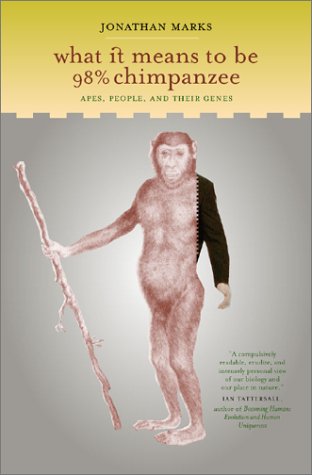
Publisher: University of California Press
Number Of Pages: 325
Publication Date: 2002-04
Sales Rank:
ISBN / ASIN: 0520900626
EAN: 9780520900622
Binding: Unbound
Manufacturer: University of California Press
Studio: University of California Press
Post-modernist persiflage
Accepting the fallacy of Marks' title, let us start on a positive note. Marks wants to keep apes and humans separate. Fair enough. I don't want to live on termites on a stick, and it's doubtful chimps want to worry about traffic congestion, tax rates or political corruption. Marks wants scientists to do their job well. Who can argue? Marks has courage - he has the temerity to assault the venerable E. O. Wilson, the articulate Richard Dawkins and the revered Jane Goodall. Marks is against racism. Hardly debatable. Marks seems a pretty upstanding fellow. Why then, is this book such an insult to the intelligence?
Mostly because it is a froth of misleading statements, misdirected wrath, misconceptions and mistaken views of science. Marks goes to unusual lengths in dismissing the research achievements of many scientists in both field and laboratory. He blithely dismisses the disclosure that chimpanzee and human genes are nearly identical as \"the most overly exposed factoid in modern science.\" It's not significant because it confuses precision with accuracy. From there, Marks goes on to castigate a legion of scientists for their failure to \"get it right\" the first time around. Few escape his lash - even Linneaus, who virtually invented classifying life, is a victim, and perpetrator, of cultural artifacts in naming species. This from a man who finds culture an unbridgeable chasm between humans and animals!
Marks spends much of the remainder of the book discussing racial/cultural undercurrents in science. He finds far too much of it in current anthropology. He's correct in this, but his case is \"overblown\"- a favourite phrase of his. In a welter of complaints, he finds but two scientists to exonerate of the charge: Richard Leowntin and - himself. He doesn't want any cultural or behavioural relationship between humans and the rest of the animal kingdom, a favourite plaint of Lewontin's. Any hint of sociobiology, which he incorrectly defines as the study of human behaviour, must be rejected. This attitude ignores the wealth of research published during the past generation.
Marks' shots against sociobiology would be amusing except that so many will accept them uncritically. Like his mentor, Marks wants humanity to evolve without any evolutionary baggage. Behavioural studies of modern animals are irrelevant according to Marks. Thus is cast aside the whole realm of Darwin's evolution by natural selection. At least as far as it concerns humans. This attitude fits adroitly with Marks' intended reader community. He blames science for many social attitudes, delving deeply into the history of science to build his case. His brief runs from Plato onward, ending with the efforts to map the human genome. Science has long suffered from its cultural roots. The case is flawed by Marks failure to recognize that all through history, science has sought to reveal natures' secrets. It's a process of fits and starts, each gain a limited success. That inability to \"get it all right the first time\" is inherent in the process. It accomplishes little to portray the process as invalid. If some people have not performed to his expectations doesn't mean science should give up trying.
The area that Marks clearly wants abandoned is understanding of what drives human beings. That some scientists want to look more deeply into the human genome he perceives as a wasted effort. Along with Lewontin, Marks rails against \"genes for\" this or that aspect of life - particularly human life. Are we to assume then that we should stop looking? Because faulty genes have been shown to invoke certain disorders but haven't been found for others, is the list now complete? He inveighs against looking for genes for criminal behaviour. We don't know enough about how DNA works to decide one way or another. Do we give up analysing how genes perform? And what exactly is criminal behaviour? Even Marks uses statistics of prison populations to build his case. But none of the Enron executives are in prison, nor are likely to be. Do we exclude them from genetic analysis to unravel what genes lead us to do?
This book will go far in inflaming the already anti-scientific attitude prevalent in North American schools. Statements such as \"science is not generally accurate\" and \"scientific statements are routinely falsified\" [p. 279] aren't likely to entice anyone into the scientific fold. Students will not be encouraged to enter science disciplines when they're told \"it is no easier to get the average scientist to accept responsibility than it is to get the average four-year-old to accept responsibility. After all, Marks is a scientist himself, his statements must be valid. We must assume, it is supposed, that he and Lewontin stand alone by having donned the mantle of responsibility. Yet his book is permeated with complaints that statements made by other scientists have been uncritically accepted. Marks owes the scientific community an apology. More importantly, he owes every young person interested in science an apology for describing them as likely to become irresponsible children instead of aspiring grown-ups. [stephen a. haines - Ottawa, Canada]
http://rapidshare.com/files/2821 ... _98__Chimpanzee.pdf |
|


 发表于 2007-4-28 20:13:15